

Automatic Number Plate Recognition (ANPR) cameras are designed to identify vehicle registration plates automatically instead of relying only on conventional video surveillance. In India, they are increasingly useful at gates, parking facilities, highways, logistics hubs, industrial sites, and traffic-management locations where knowing which vehicle entered, exited or passed through matters as much as seeing the vehicle itself.
Key Takeaways
ANPR cameras automatically detect and read vehicle registration plates and can associate plate data with vehicle images, direction or other vehicle attributes depending on the system.
The best ANPR camera is application-specific: speed, lane width, capture distance, lighting, plate visibility and camera angle matter as much as megapixel count.
Parking, factories, logistics hubs, highways, traffic junctions and gated facilities are practical B2B applications for ANPR in India.
Look beyond resolution when buying: check shutter control, lens/focal length, WDR, IR illumination, capture distance, recognition speed, storage, integration and weather protection.
Installation is part of ANPR performance. Incorrect camera angle, excessive vehicle speed, poor plate pixel density or uncontrolled lighting can reduce recognition quality even when the camera specification looks strong.
What Is an ANPR Camera?
An ANPR camera is a surveillance camera that automatically detects and recognizes vehicle registration plates from captured images. ANPR is also commonly called LPR, or License Plate Recognition, and can be used to convert a visible plate into searchable vehicle information.
A conventional CCTV camera primarily answers “What happened?” An ANPR system adds another question: “Which vehicle was involved?”
Depending on the camera and software, an ANPR deployment may record the plate image, full vehicle image, date and time, direction of travel, vehicle type, or other attributes. HiFocus's current ANPR camera range includes features such as license plate recognition, vehicle-type detection, vehicle counting and traffic-monitoring capabilities.
How Does ANPR Work?
ANPR works by detecting a vehicle, locating its registration plate, capturing a sufficiently clear image and using recognition algorithms to extract the plate characters. The resulting information can then be stored, searched or integrated with another security or traffic-management system.
A typical deployment follows this sequence:
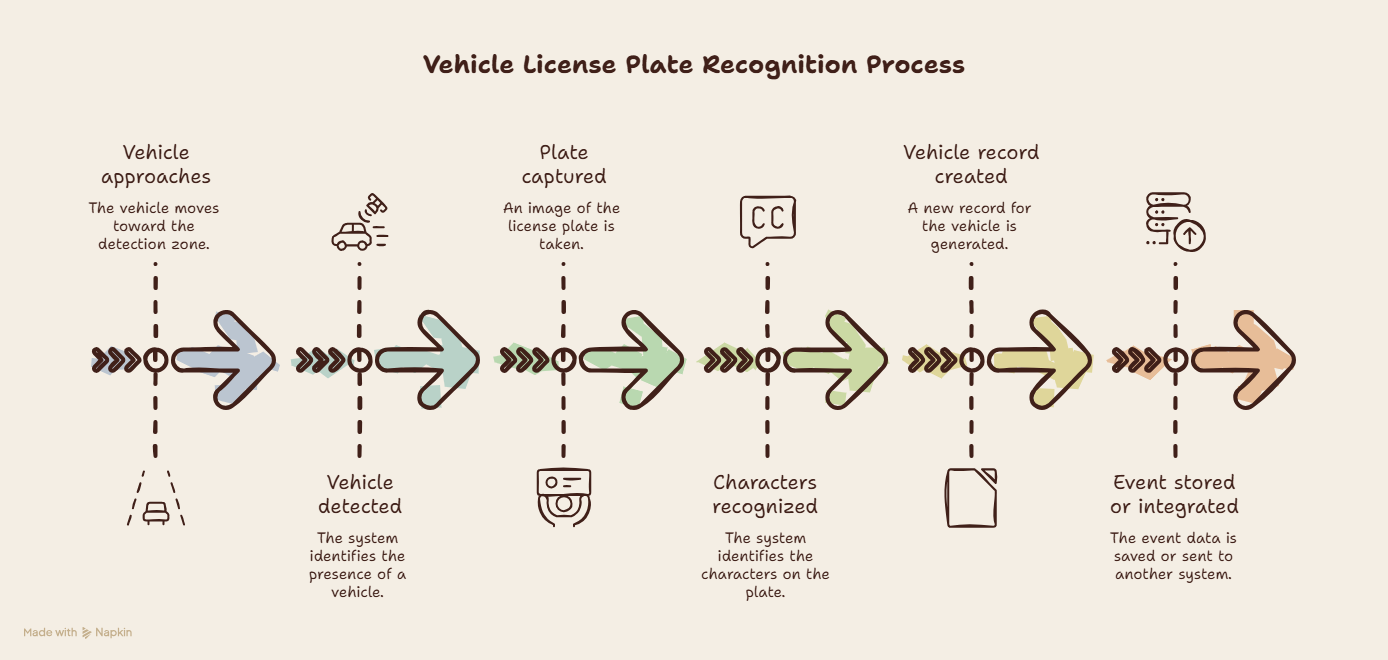
The important point is that recognition depends on the quality of the plate image, not simply the camera's advertised resolution.
For example, HiFocus's 4MP ANPR camera specification includes adjustable electronic shutter, motorized lens options, 120dB WDR, IR illumination, LPR functions and capture-speed ranges up to 80 km/h or 120 km/h depending on the configuration.
Where Are ANPR Cameras Used in India?
ANPR cameras are most useful wherever vehicle identity needs to be recorded, verified, searched or linked to an operational event. The strongest B2B applications include traffic management, parking, gated facilities, highways, logistics and industrial access points.
Application | What ANPR helps capture | Typical requirement |
Parking facilities | Vehicle entry/exit and plate number | Short-range controlled capture |
Factories & industrial sites | Employee, vendor and visitor vehicles | Gate identification and access records |
Logistics & warehouses | Trucks, containers and delivery vehicles | Vehicle movement and dispatch monitoring |
Highways | Passing vehicles and plate records | Longer capture distance and higher speed |
Traffic junctions | Vehicle movement and enforcement data | Fast capture, multiple lanes and integration |
Gated communities | Resident and visitor vehicles | Entry/exit automation |
Airports & institutions | Authorized and unauthorized vehicles | Access control and audit trails |
Safe-city projects | Vehicle intelligence across road networks | Centralized analytics and integration |
HiFocus's solutions portfolio specifically includes traffic management, highways, parking lots, logistics and warehouses, vehicle detection and Safe City deployments, making ANPR a component of a broader surveillance architecture rather than a standalone camera purchase.
For example, HiFocus describes its traffic-management CCTV solution as combining surveillance, ANPR and AI-driven analytics for traffic monitoring and enforcement.
Is ANPR Useful for Factories, Warehouses and Logistics?
Yes. ANPR can create a searchable vehicle trail at gates, loading areas and dispatch points, which is particularly useful where many vehicles move through a site every day.
At a logistics facility, for example, an ANPR camera can be positioned at the entry or exit lane to capture truck plates while another CCTV camera provides a wider contextual view of the gate. This distinction matters: the ANPR camera should be specified for plate capture, while general surveillance cameras can cover people, cargo and surrounding activity.
HiFocus's logistics and warehouse CCTV solution focuses on vehicle activity, perimeter security, centralized monitoring and intelligent video analytics across warehouses and transportation environments.
For factories, ANPR can support:
Employee and contractor vehicle identification
Visitor vehicle logging
Gate-in/gate-out records
Vehicle-based access workflows
Investigation of disputed vehicle movements
Integration with access-control or site-management systems
What Should You Check Before Buying an ANPR Camera?
The most important ANPR buying criteria are capture distance, vehicle speed, lens selection, shutter control, lighting performance, recognition capability and integration, not megapixels alone.
1. Capture distance and lens
The camera must produce a sufficiently large plate image at the actual point where the vehicle passes. HiFocus's 4MP ANPR model lists recommended ANPR distances ranging from approximately 3–8 metres to 16–48 metres depending on the selected lens, showing why focal length must be matched to the site rather than selected generically.
2. Shutter speed
Fast-moving vehicles require appropriate shutter settings to limit motion blur. Axis's license-plate capture guidance notes that excessive shutter time can cause motion blur and that the appropriate maximum shutter depends on vehicle speed and camera alignment. (Axis White Papers)
This is why an ANPR camera intended for a highway approach should not be specified in the same way as one used at a slow-moving factory gate.
3. WDR and exposure control
WDR and exposure management help when vehicles move between bright outdoor light and darker entry lanes. HiFocus's current 4MP ANPR models specify True WDR up to 120dB alongside HLC, BLC, defog, and noise-reduction functions.
4. IR illumination
Night-time ANPR needs controlled illumination so the plate remains readable without excessive glare. HiFocus's listed ANPR cameras include IR/LED illumination, with model-dependent ranges reaching approximately 70–100 metres.
5. Plate image quality
The plate needs to occupy enough pixels in the captured image for reliable recognition. As a practical reference, Hanwha's ANPR guidance recommends a plate width of approximately 130–400 pixels and limits plate roll to less than 5°, with pitch and yaw below 30° for its system. (Hanwha Vision Support)
These figures should not be treated as universal specifications for every ANPR platform, but they demonstrate an important installation principle: camera positioning and plate size within the image directly affect recognition performance.
What Camera Angle Is Best for ANPR?
The camera should be positioned so vehicles pass through a controlled recognition zone with the plate facing the camera as directly as practical. Excessive horizontal or vertical angles can make the plate smaller, distorted or partially obscured.
This becomes especially important at gates where vehicles turn sharply before reaching the camera. Hanwha's current support guidance specifically recommends adjusting camera angle and recognition areas when recognition rates are poor and notes that capturing the front of vehicles can sometimes provide better results than rear-plate capture because of shadows and vehicle design. (Hanwha Vision Support)
Before installation, check:
Vehicle approach direction
Lane width
Camera mounting height
Horizontal and vertical angle
Capture distance
Expected vehicle speed
Headlight and sunlight direction
Night-time lighting
Plate visibility
Number of lanes
A short site survey can prevent an expensive ANPR camera from being installed in the wrong position.
Do ANPR Cameras Need an NVR or VMS?
Not always, but most commercial ANPR deployments benefit from integration with an NVR, VMS or another management platform. The correct architecture depends on whether the requirement is simply plate capture or centralized vehicle intelligence across multiple cameras and locations.
HiFocus's ANPR category lists compatibility with ONVIF-supported systems and related categories including NVRs, PoE switches and VMS servers.
Some HiFocus ANPR models also provide local microSD storage and network storage, while the 4MP HC-IPC-T4214-0360G supports ONVIF, SDK/API integration, PoE and up to 256GB microSD storage.
For a single gate, camera + NVR may be sufficient. For a multi-site traffic or logistics deployment, a VMS or centralized application can make searching and managing vehicle events considerably more practical.
What About ANPR on Highways and High-Speed Roads?
Highway ANPR requires more careful optical and installation planning than a low-speed gate because vehicle speed, capture distance and lane geometry directly affect plate recognition.
HiFocus's highway solution specifically positions ANPR alongside traffic monitoring, intelligent analytics and real-time monitoring.
For higher-speed applications, pay particular attention to:
Required capture speed
Lens and optical zoom
Shutter-speed control
IR reach
Vehicle-to-camera distance
Lane coverage
Plate pixel density
Weather and visibility
Multi-lane architecture
Integration with the wider traffic-management platform
A camera rated for a certain capture speed should not automatically be assumed to deliver that performance in every installation. The site geometry and lighting must support the camera's operating conditions.
Is ANPR Suitable for Parking Lots?
Yes. Parking is one of the most straightforward commercial applications for ANPR because vehicle movement is concentrated around defined entry and exit points.
At a parking facility, ANPR can support vehicle logging, entry/exit monitoring, parking operations and investigation of vehicle-related incidents. HiFocus's parking-lot surveillance solution specifically includes vehicle tracking, number plate recognition and entry-exit monitoring.
For a controlled parking entrance, the camera should generally be installed after identifying the exact vehicle stopping or slowing point. This makes the recognition zone predictable and reduces unnecessary variation in plate size and angle.
What About Data Privacy and ANPR Records in India?
Organizations using ANPR should treat vehicle and plate records as sensitive operational data and design appropriate access, retention, and security controls. India's Digital Personal Data Protection Act, 2023 establishes a framework for processing digital personal data, while the Digital Personal Data Protection Rules, 2025 were notified by MeitY in November 2025 with a phased implementation timeline. (MeitY)
The practical requirement for a business is to define why ANPR data is being collected, who can access it, how long it is retained, and how it is protected. For deployments connected to access control, employee systems, customer records, or other personal data, the organization should assess its specific obligations under applicable law and its own privacy policies.
How Do You Choose the Right ANPR Camera?
Start with the vehicle movement and recognition requirement, then select the camera, not the other way around.
Use this specification sequence:
Define the application: parking, factory gate, logistics, highway or traffic.
Measure the capture point: distance, lane width and camera mounting position.
Estimate vehicle speed: slow gate traffic and highway traffic require different optical settings.
Select the lens: match focal length to the required recognition distance.
Check shutter and image controls: especially for moving vehicles.
Check WDR and night illumination: account for headlights, sunlight and low light.
Verify recognition functions: plate detection, direction, vehicle type and required attributes.
Check integration: ONVIF, API/SDK, NVR, VMS, access control or traffic platform.
Plan storage: local SD, NVR or centralized storage according to retention needs.
Validate the installation: test actual plate capture during representative day and night conditions.
HiFocus's current ANPR category includes 2MP and 4MP ANPR network cameras, with selected 4MP models offering motorized lens options, LPR, vehicle-type detection, up to 120dB WDR, PoE, IP67 protection and local storage.
If you are specifying an ANPR system for a gate, parking facility, factory, logistics hub or road application, the camera should be selected after the site geometry and vehicle movement have been defined.
Why HiFocus for ANPR Deployments in India?
HiFocus is a Chennai-based Indian CCTV brand serving business, institutional and infrastructure surveillance requirements across India. Its ANPR portfolio includes network cameras designed around license-plate recognition, vehicle detection, outdoor protection, IR illumination, PoE, local storage and network integration.
The broader HiFocus solutions portfolio also covers traffic management, highways, parking, logistics, vehicle detection and Safe City applications, allowing ANPR to be considered as part of a complete surveillance architecture rather than an isolated camera.
Planning an ANPR deployment? Talk to HiFocus about the camera, lens, capture distance, lighting, recording and integration requirements for your site.
Conclusion
ANPR cameras are not simply higher-resolution CCTV cameras. They are specialized surveillance devices designed around a specific task: capturing and recognizing vehicle registration plates reliably within a defined operating zone.
For Indian businesses and infrastructure operators, the strongest applications include parking facilities, factory gates, logistics hubs, warehouses, highways, traffic-management projects and controlled-access facilities.
The right buying decision starts with the site: vehicle speed, distance, lane geometry, lighting and plate visibility. From there, evaluate lens selection, shutter control, WDR, IR, recognition capabilities, integration, storage and environmental protection. When those elements are specified together, ANPR becomes much more useful as an operational tool rather than simply another CCTV feed.
Frequently Asked Questions
What is an ANPR camera?
An ANPR camera is a surveillance camera that automatically detects and recognizes vehicle registration plates. Depending on the model and system, it can also capture vehicle images, direction, vehicle type and other attributes.
What is the difference between ANPR and normal CCTV?
Normal CCTV primarily records visual footage, while ANPR is designed to extract vehicle plate information from captured images. A strong deployment often uses both: ANPR for vehicle identification and conventional CCTV for wider scene context.
Where are ANPR cameras used?
ANPR cameras are commonly suited to parking entrances, factory gates, logistics facilities, highways, traffic-management locations, gated communities and institutional access points. The best application is one where vehicle movement is predictable enough to create a controlled recognition zone.
What resolution is required for an ANPR camera?
There is no universal megapixel requirement because lens selection, capture distance, vehicle speed and plate pixel density are equally important. HiFocus currently offers 2MP and 4MP ANPR network camera options, with selected 4MP models providing motorized lens configurations and dedicated LPR functions. (Hi-Focus)
Can ANPR work at night?
Yes, provided the camera and installation are designed for night-time plate capture. Controlled IR illumination, suitable exposure settings, appropriate shutter speed and correct camera positioning are important because headlights and reflective plates can otherwise create overexposure.
Can ANPR cameras be used for parking management?
Yes. ANPR is particularly suitable for controlled parking entrances and exits where vehicles pass through predictable capture points. It can support vehicle logging, entry/exit monitoring and integration with wider parking or access-control systems. (Hi-Focus)
Do ANPR cameras need an NVR?
An ANPR camera does not necessarily need an NVR for every deployment, but an NVR or VMS can provide useful centralized recording and management. The appropriate architecture depends on the number of cameras, retention requirements and whether the ANPR data needs to integrate with other systems.
What should I check before buying an ANPR camera in India?
Check capture distance, lens/focal length, vehicle speed, shutter control, WDR, IR illumination, plate pixel density, recognition functions, storage, network protocols, integration options and IP/weather protection. A site survey should be completed before finalizing the camera model.