Night-time is when security matters most. Most incidents of theft, trespassing, vandalism happen after hours, in low light, when standard cameras are practically blind. That is why every serious business CCTV setup needs cameras that genuinely work in the dark.
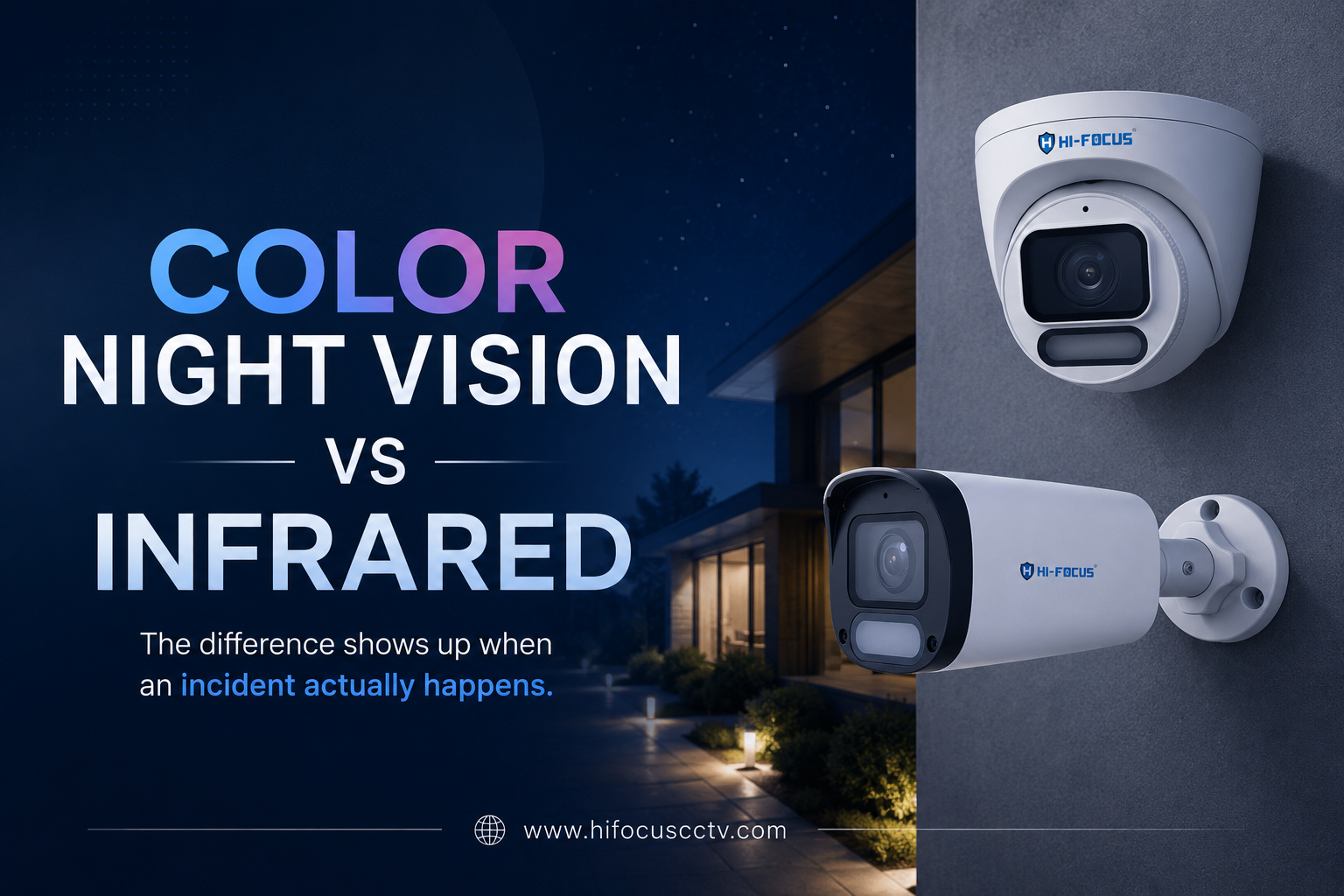
Two technologies dominate here: traditional infrared (IR) night vision and the newer color night vision. Both capture footage in darkness. But they do it differently, and the gap between them matters more than most people realise when an actual incident occurs.
How Each Technology Works
Infrared (IR) Night Vision uses built-in IR LEDs that emit light invisible to the human eye. The camera sensor picks up this reflected infrared light and produces footage, but the result is always black-and-white. The camera automatically switches to IR mode once ambient light drops below a threshold.
Color Night Vision uses a combination of high-sensitivity image sensors, wide-aperture lenses, and often a white light LED to capture full-colour footage in near-darkness. Some advanced cameras, like the HiFocus Dark Hunter series, use an F1.0 lens with a large 1/1.8" sensor to pull in available light and produce daylight-like images without flooding the area with white light.
The Real Difference: What Your Footage Actually Shows
This is where the choice becomes practical. Imagine a person in a red jacket entering your premises at 2 AM. An infrared camera shows a figure in greyscale, identifiable as a person, but the jacket is just a shade of grey. A colour night vision camera shows the red jacket clearly.
For businesses where post-incident identification matters, such as retail stores, office lobbies, warehouses, and parking lots, colour detail in footage is not a luxury. It is evidence.
What You Need to Identify | Infrared (IR) | Color Night Vision |
Person was present | Yes | Yes |
Face detail | Partial | Better |
Clothing colour | No | Yes |
Vehicle colour | No | Yes |
Number plate (at range) | Moderate | Better in well-lit zones |
Direction of movement | Yes | Yes |
Where Infrared Still Makes Sense
IR is not obsolete. It has clear advantages in specific situations, and for many businesses it remains the right choice.
Long-range outdoor coverage. HiFocus IR cameras can illuminate up to 100 metres in complete darkness. Colour night vision cameras with white LEDs work best within 20 to 30 metres. For monitoring large open grounds, perimeters, or long driveways, IR simply reaches further.
Discreet surveillance. IR LEDs are invisible. White light LEDs announce the camera's presence, which may deter entry at the front gate but can be a disadvantage in covert monitoring situations inside a facility.
Lower cost at scale. If you are deploying 32 or 64 cameras across a warehouse or factory, IR cameras remain more cost-effective than color night vision equivalents. For large-channel deployments connected to a HiFocus NVR or HVR, the cost difference per camera adds up.
Already-lit environments. If your car park, loading dock, or perimeter has sodium vapour or LED street lighting, even a basic IR camera will produce usable footage. The ambient light does most of the work.
Good fit for IR: Large outdoor areas, perimeter walls, long driveways, industrial yards, and any high-channel deployment where cost per camera matters.
Where Color Night Vision Wins for Businesses
Entry and exit points. A shop entrance, office lobby, or building gate is exactly the kind of location where colour matters. You want to see what someone was wearing, what they were carrying, and the colour of the vehicle they arrived in.
This is where a purpose-built camera like the HiFocus 4MP Bullet Dark Hunter Network Camera makes a real difference. It combines a high-sensitivity 4MP sensor with dual-light technology, delivering full-colour footage at night without compromising on outdoor durability.
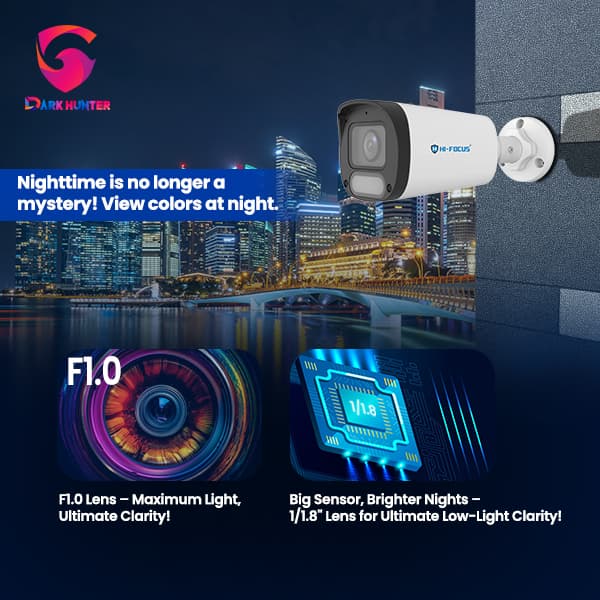
For a business entrance, parking area, or perimeter gate, it gives you footage that is actually usable when filing a police complaint or reviewing an incident, not just a greyscale shape on a screen.
Retail and loss prevention. Inside a store, petrol station, pharmacy, or showroom that operates late, colour footage makes incident review far more reliable. Identifying a suspect from greyscale footage is a genuinely harder task for security personnel and investigators.
ATM lobbies and banking areas. Financial spaces require footage that holds up legally and operationally. Colour footage is more useful in these contexts than a monochrome image that can be difficult to act on.
Reception and co-working spaces. Areas with controlled access and visitor traffic benefit from colour footage because the goal is identification, not just detection.
Good fit for Color Night Vision: Retail counters, shop floors, office entrances, ATM vestibules, hotel lobbies, and any location where identifying people and objects, not just detecting movement, is the priority.
The Dual-Light Advantage: Best of Both
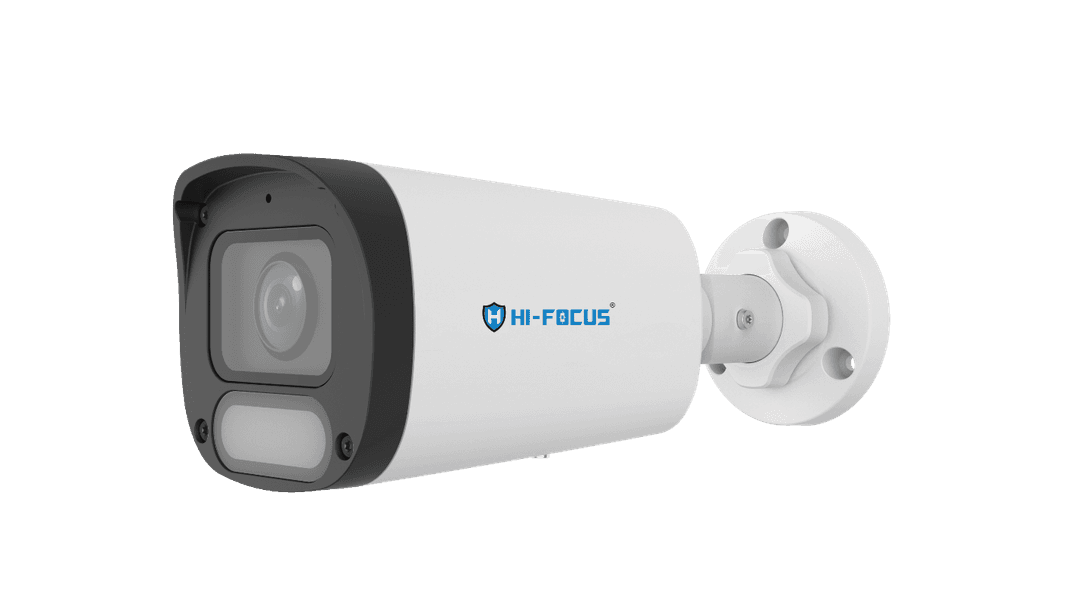
Many businesses do not want to choose strictly between IR and colour. That is where dual-light cameras come in, and the HiFocus 4MP Bullet Dark Hunter Network Camera is built around exactly this idea. It carries both IR LEDs and white light LEDs in a single weatherproof bullet housing.
By default, it captures colour footage using white light, but in situations where constant illumination is not appropriate, a quiet residential street nearby, or an area where a bright flash would disturb operations, it can switch to IR automatically.
For outdoor business locations across India, where conditions shift from heavy daytime traffic to quiet overnight hours, this kind of flexibility removes the guesswork from camera selection. You get colour footage when it matters and discreet IR coverage when it is needed, from a single unit rated for outdoor installation.
A Quick Decision Guide
Choose IR when:
Cameras need to cover more than 30 metres in darkness
You are monitoring large open outdoor areas
Covert or non-intrusive surveillance is a priority
Budget is a constraint across a large camera count
Choose Color Night Vision when:
Entry points, lobbies, or cashier areas need to be covered
Post-incident identification of people or vehicles is important
The area already has some ambient light
You need footage quality that holds up in legal or insurance contexts
Consider dual-light cameras when:
You want colour footage without permanently illuminating an area
The location switches between busy hours and quiet overnight periods
A single camera needs to serve multiple lighting conditions across a 24-hour cycle
For businesses managing multiple sites or a large camera network, HiFocus VMS lets you review and manage footage from all camera types through a single interface. If you want advice on which camera suits each zone in your premises, the HiFocus team is available here.
Frequently Asked Questions
Does color night vision work in complete darkness?
Color night vision cameras with white LED illumination activate the LEDs in complete darkness to produce colour footage. Sensor-based colour cameras need at least some ambient light to work well without LEDs.
Do infrared cameras capture colour footage during the day?
Yes. IR cameras operate in full colour during daylight and switch to black-and-white IR mode only when ambient light drops below the camera's threshold, typically at dusk or in darkened interiors.
Is color night vision more expensive than IR?
Generally, yes, though the gap has narrowed. For small deployments of 4 to 8 cameras, the difference is manageable. For large-scale projects, evaluate cost per zone rather than just cost per camera.
Will white light LEDs disturb people at night?
Placement and intensity determine this. For sensitive locations, a dual-light camera like the HiFocus 4MP Bullet Dark Hunter defaults to IR when white light is not appropriate.
Can I mix IR and color night vision cameras on the same NVR?
Yes. Both types connect and record normally on a HiFocus NVR with no compatibility issues, and footage displays side by side without any configuration needed.