

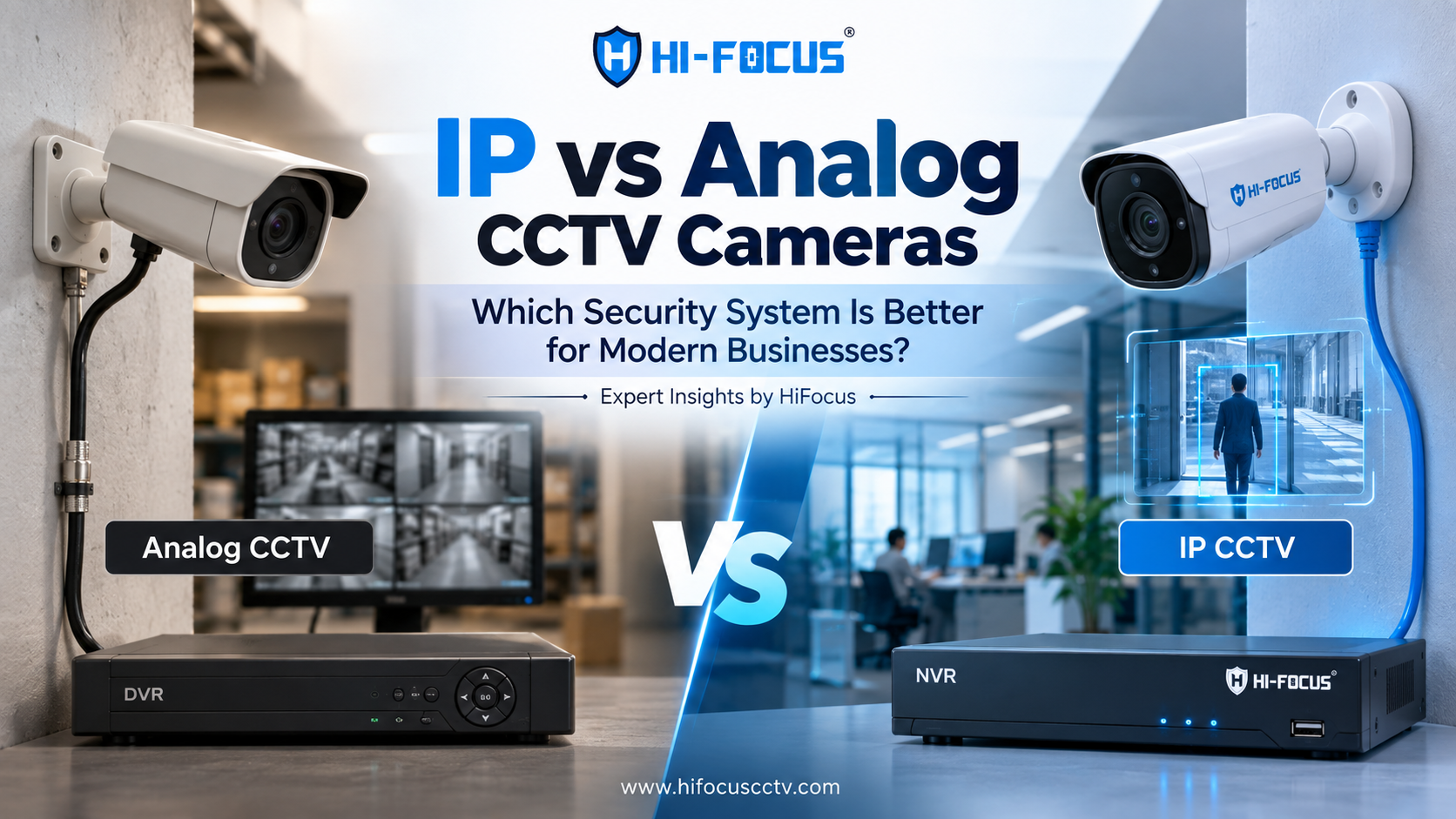
For a business, CCTV is no longer just about recording what happened after an incident. Modern surveillance systems are expected to provide clear video, remote access, intelligent alerts, easier expansion, and better control across multiple locations. This is where the difference between IP and analog CCTV cameras becomes important. Analog systems can still make sense for simple, budget-conscious installations, particularly when existing coaxial cabling and DVR infrastructure are already in place.
But for new commercial projects, IP cameras offer a more flexible foundation for high-resolution video, networking, AI analytics, remote monitoring, and future expansion. So, IP vs analog CCTV cameras: which is better for a modern business? In most new business deployments, IP is the stronger long-term choice.
Key Takeaways
Analog CCTV cameras typically use coaxial cable and a DVR for recording, making them relatively simple and cost-effective for smaller or existing installations.
IP cameras transmit digital video over a network and can support higher resolutions, PoE, remote management, and advanced analytics.
IP systems are generally easier to scale across offices, warehouses, retail outlets and large commercial sites.
Modern analog HD cameras are better than the old low-resolution CCTV systems many people associate with analog surveillance.
IP vs Analog CCTV: Understanding the Basic Difference
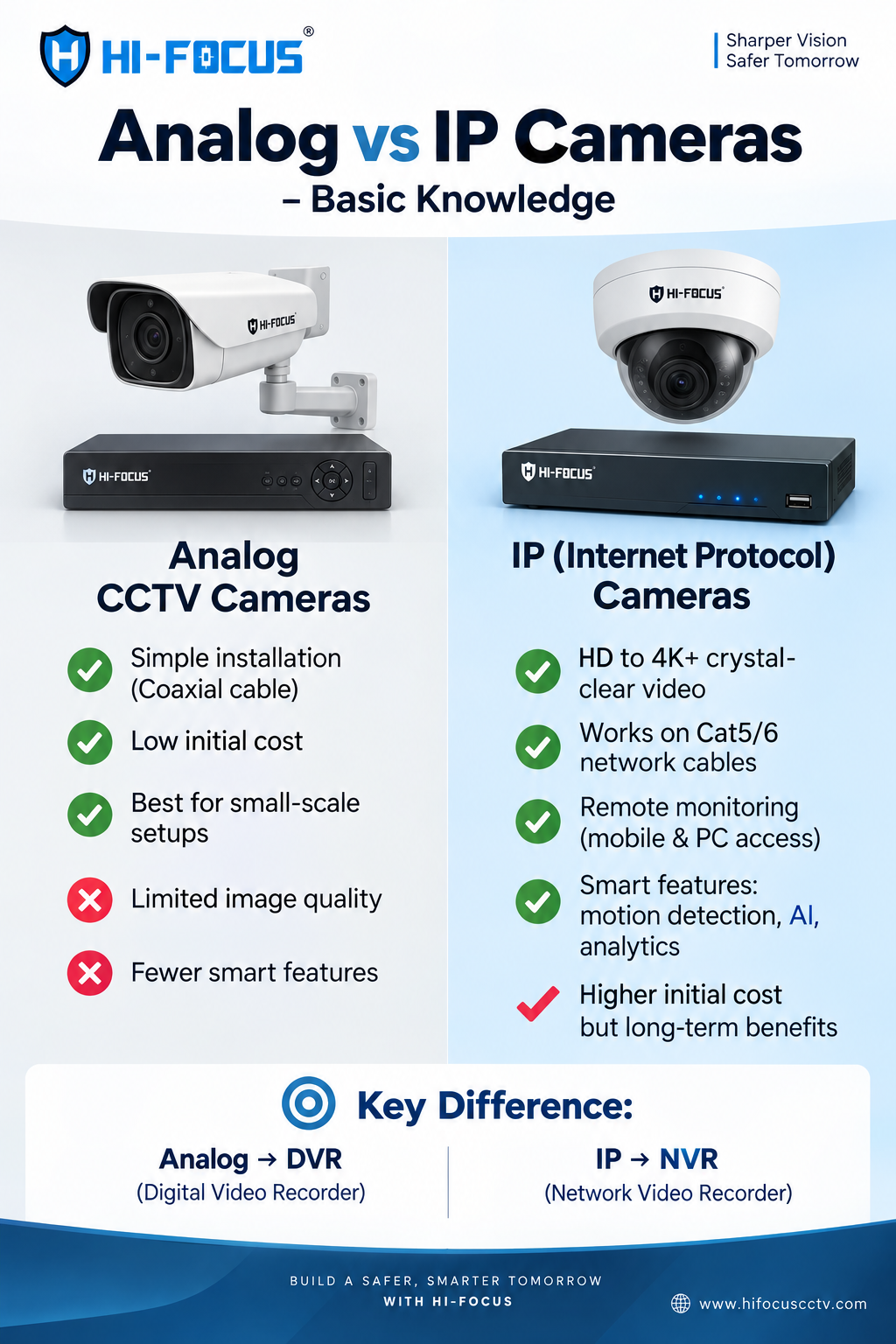
At the simplest level, the difference comes down to how the camera captures, processes, and sends video.
An analog CCTV camera sends its video signal through coaxial cable to a DVR (Digital Video Recorder). The DVR processes and stores the footage. This architecture has been used for decades and remains practical for many basic surveillance applications.
An IP camera, by contrast, captures video digitally and transmits it over a computer network. It can connect through Ethernet cabling, often using PoE (Power over Ethernet), and you can manage the footage through an NVR, VMS, or other compatible network infrastructure.
This network-based architecture is one reason IP surveillance has become increasingly important for commercial security.
According to Mordor Intelligence's India surveillance IP camera market research, India's surveillance IP camera market was estimated at approximately US$2.17 billion in 2025, with the market projected to grow to US$4.19 billion by 2030.
IP vs Analog CCTV Cameras: Detailed Comparison
Feature | Analog CCTV Cameras | IP CCTV Cameras |
Video transmission | Coaxial cable | Ethernet/network cable |
Main recorder | DVR | NVR |
Video format | Analog signal converted by DVR | Digital video |
Typical connectivity | Coaxial + separate power | Ethernet, often PoE |
Image quality | Good to high on modern HD analog models | Generally higher flexibility for HD/4K and beyond |
Remote viewing | Possible through DVR/network setup | Native strength of network architecture |
Installation | Simple for smaller systems | Requires network planning |
Scalability | More dependent on DVR/channel and cabling | Highly scalable through network infrastructure |
AI analytics | Limited/model dependent | Broad range of camera/NVR/VMS-based analytics |
Smart integration | More limited | Stronger integration possibilities |
Multi-site management | Possible but less flexible | Well suited to centralized network management |
PTZ integration | Available | Strong network-based PTZ control |
PoE support | No | Yes, on compatible systems |
Existing coax infrastructure | Major advantage | May require network cabling/conversion |
Initial cost | Usually lower for basic setups | Usually higher for comparable entry-level deployments |
Long-term flexibility | Moderate | High |
Best suited for | Small/basic or existing installations | New commercial, enterprise and scalable deployments |
What Are Analog CCTV Cameras?

Analog CCTV cameras transmit video using traditional CCTV cabling, most commonly coaxial cable, to a DVR. For a small shop, office, residential property, or an existing site with functioning coaxial infrastructure, this can be a practical solution.
Advantages of Analog CCTV
1. Lower initial investment
Basic analog systems can be economical when the requirement is straightforward surveillance without extensive smart functionality.
2. Simple architecture
The basic structure is easy to understand:
Camera → Coaxial Cable → DVR → Monitor/Network
For smaller installations, this simplicity can make deployment and maintenance easier.
3. Useful for existing CCTV infrastructure
Businesses that already have coaxial cables installed may be able to upgrade cameras or recorders without completely redesigning their cabling infrastructure.
4. Suitable for basic monitoring
If the objective is simply to monitor entrances, corridors, counters, storage areas, or other fixed locations, an analog system can still perform effectively.
Where Analog Starts Showing Its Limitations
The limitations become more noticeable when the business wants:
Large-scale expansion
Advanced AI analytics
Centralized multi-site management
Extensive remote monitoring
Flexible network integration
Higher-resolution video across a large deployment
Easier integration with modern security systems
What Are IP CCTV Cameras?
_1782544924486_cae551513d57.png&w=1080&q=75)
An IP camera, or Internet Protocol camera, is a digital surveillance camera that communicates over a network. Instead of sending an analog video signal through coaxial cable, the camera sends digital video data through an IP network.
A typical deployment may look like:
IP Camera → PoE Switch → Network → NVR/VMS → Storage & Monitoring
The network architecture creates considerably more flexibility.
HiFocus offers a broad range of IP cameras for commercial and institutional surveillance, including bullet, dome, varifocal, specialized low-light, fisheye, solar-powered,d and other network camera options.
Depending on the model and application, HiFocus IP cameras are available from 2MP through 8MP, with features such as PoE, advanced compression, night vision, and compatibility with network video recorders.
Why IP Cameras Are Better Suited to Modern Businesses
For modern businesses, CCTV is increasingly expected to do more than record footage. IP cameras combine high-resolution video, network connectivity, remote access, and smart analytics, making them better suited to evolving security requirements.
Scalable: Easily expand from a few cameras to large, multi-site surveillance networks.
Higher image quality: Supports HD, 4K, and advanced imaging for better identification of people, vehicles, and incidents.
Remote monitoring: Security teams can view and manage cameras from PCs or mobile devices across locations.
AI-ready: Supports intelligent features such as person/vehicle detection, intrusion alerts, people counting, and video analytics, depending on the system.
Simpler infrastructure: PoE can carry both power and video over a single Ethernet cable, reducing cabling complexity.
Future-ready: Easier to integrate with NVRs, VMS platforms, access control, and other connected security technologies.
In short, IP cameras provide businesses with a flexible surveillance foundation that can grow from basic monitoring into a smarter, more connected security system.
IP Cameras and AI: The Bigger Advantage
This is where the difference between traditional CCTV and modern surveillance becomes particularly clear.
A conventional CCTV system primarily answers: "What happened?"
An intelligent surveillance system aims to help answer: "What is happening, where is it happening, and does someone need to act?"
Depending on the camera, NVR, R or VMS, modern systems can support functions such as:
Person detection
Vehicle detection
Intrusion detection
Line crossing
Motion detection
Face-related analytics
Object detection
Loitering detection
People counting
Video search
This does not mean every IP camera automatically includes every AI feature. Analytics depend on the specific camera, NVR, software, and configuration.
For businesses, however, the IP architecture provides a much stronger platform for adding these capabilities.
What About NVRs?
If you're moving from analog to IP CCTV, one of the biggest terminology changes is the recorder.
Analog systems generally use a DVR.
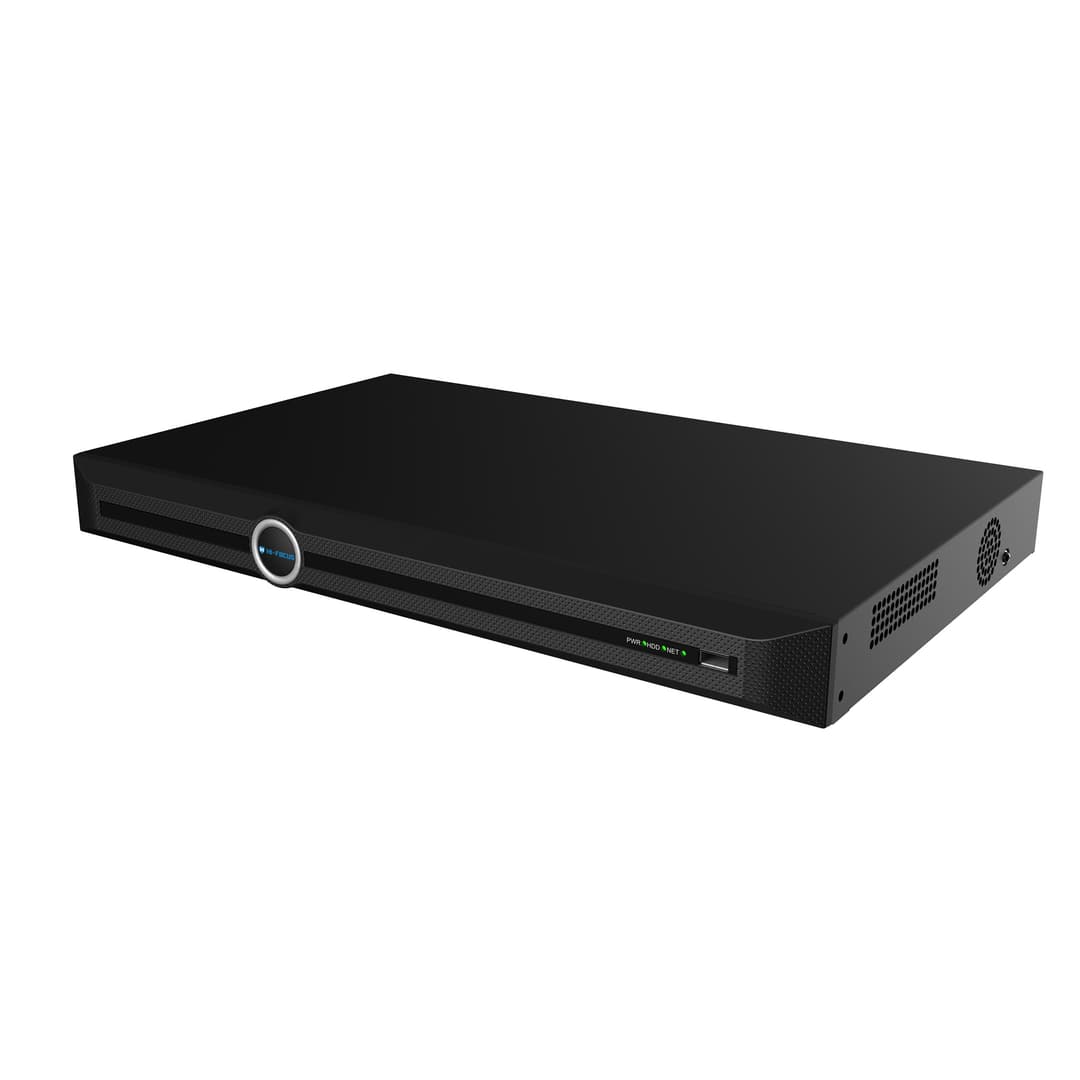
IP systems generally use an NVR - Network Video Recorder.
An NVR receives and manages network video streams from IP cameras and provides centralized recording, playback, and system management.
HiFocus offers a broad range of high-performance NVR systems, including different channel capacities and PoE-enabled options for various surveillance deployments.
When choosing an NVR, businesses should consider:
Number of cameras
Camera resolution
Recording days required
Storage capacity
Incoming bandwidth
Number of HDD bays
AI capabilities
Remote access requirements
Future camera expansion
Choosing the recorder only according to the current camera count can create problems when the system expands later.
Which CCTV System Is Better for Modern Businesses?
For most new commercial and enterprise installations, IP CCTV is the better choice.
That is especially true when the business requires:
High-resolution surveillance
Remote monitoring
AI-powered analytics
Multiple camera types
Centralized management
Multi-site deployment
Future scalability
PoE infrastructure
NVR-based recording
Integration with broader security systems
Why Businesses Are Moving Towards IP Surveillance
The broader Indian surveillance market is also moving toward network-based systems.
Mordor Intelligence's India video surveillance market analysis reports that IP deployments accounted for 54.73% of India's video surveillance market in 2025, with the IP segment projected to grow at a 10.82% CAGR through 2031.
The precise market share varies between research methodologies, but the direction is clear: businesses increasingly want surveillance systems that do more than record video.
At the same time, cybersecurity is becoming an increasingly important consideration for connected surveillance.
The Government of India's CCTV security requirements published through BIS address areas including authentication, access control, encrypted data transmission, software security, and penetration testing.
For businesses deploying network-connected cameras, security therefore needs to be considered alongside image quality.
Choosing the Right CCTV Architecture for Your Business
A practical decision framework looks like this:
Choose Analog CCTV when:
You already have extensive coaxial infrastructure.
The surveillance requirement is relatively simple.
The site is small.
Advanced analytics are not a priority.
Budget is the primary concern.
You don't expect major expansion.
Choose IP CCTV when:
You're building a new surveillance system.
You need high-resolution video.
Remote monitoring is important.
You want AI analytics.
The business may expand.
You have multiple locations.
You need PoE.
You want centralized NVR/VMS management.
You want a platform that can evolve with future security requirements.
Consider Wi-Fi/4G cameras when:
Running cables is difficult.
The site is temporary.
Broadband infrastructure isn't available.
You need rapid deployment.
The location is remote.
Consider PTZ cameras when:
You need to monitor large open areas.
Operators need remote zoom.
The surveillance area changes frequently.
Long-distance observation is important.
Why HiFocus for Business CCTV Solutions?
Choosing the right technology is only one part of a successful surveillance project. The camera, recorder, network, storage, installation design, and analytics need to work together.
HiFocus provides a broad portfolio covering IP cameras, NVRs, PTZ cameras, smart Wi-Fi/4G cameras,s and other surveillance infrastructure, allowing businesses and system integrators to build solutions around different site requirements.
From a small commercial property to a large industrial or institutional deployment, the focus should be on selecting the right combination rather than simply installing the maximum number of cameras.
Businesses evaluating Indian CCTV brands can also explore HiFocus's detailed guide to top CCTV brands in India to understand the broader Indian surveillance landscape.
Frequently Asked Questions
1. Which is better, IP or analog CCTV?
For most new business installations, IP CCTV is the better choice because it offers greater scalability, network connectivity, remote management,nt and support for advanced analytics. Analog can still be practical for small or existing coaxial-based installations.
2. Is IP CCTV more expensive than analog CCTV?
The initial investment for IP CCTV can be higher, particularly when a new network infrastructure is required. However, the long-term value can be better when the business needs scalability, remote monitoring, AI analytics, and future expansion.
3. Can IP cameras work without the internet?
Yes. IP cameras can operate on a local network without internet access. Internet connectivity is generally required for features such as remote access from outside the local network or certain cloud-based services.
4. Do IP cameras need an NVR?
Not always. IP cameras can support local storage, edge storage,e or integration with VMS platforms depending on the model. However, an NVR provides centralized recording and management and is commonly used in professional multi-camera systems.
5. Can I use existing coaxial cables for IP cameras?
Traditional coaxial cabling is designed for analog video. Converting an existing coax infrastructure to IP may be possible with appropriate technologies or equipment, but a proper site assessment is recommended before deciding whether to reuse or replace the cabling.
6. Are IP cameras better for AI surveillance?
Generally, IP systems provide a stronger platform for AI-based surveillance because modern network cameras, NVRs, Rs and VMS platforms can process and manage analytics such as person detection, vehicle detection, intrusion, and other intelligent events.
7. What is the difference between DVR and NVR?
A DVR is generally used with analog camera systems and processes video from coax-connected cameras. An NVR is designed for network cameras and manages digital video streams transmitted over an IP network.
8. Are Wi-Fi CCTV cameras suitable for businesses?
They can be suitable for smaller offices, retail locations, temporary sites,s and areas where cabling is difficult. For large or mission-critical commercial installations, wired IP/PoE cameras are generally preferable because of their predictable network connectivity.
9. When should I use a PTZ CCTV camera?
PTZ cameras are useful for large areas such as industrial campuses, parking facilities, warehouses, highways, and perimeters where operators need to remotely pan, tilt, or optically zoom toward specific areas.
10. How do I choose the right CCTV system for my business?
Start with the areas that need protection, lighting conditions, required identification distance, number of cameras, recording duration, network infrastructure, remote monitoring requirements, and future expansion plans. Then select the appropriate combination of fixed IP cameras, PTZ cameras, Wi-Fi/4G cameras, NVRs, and other equipment.