If you are planning or upgrading a surveillance system for a large enterprise, a multi-site campus, or a government facility in India, you have likely run into this question early in the planning stage: Should we go with an NVR-based setup or invest in a VMS?
It is not a simple vendor choice. It is an architectural decision that affects your hardware costs, day-to-day operations, scalability, IT dependency, and long-term flexibility.
This guide breaks down the VMS vs NVR comparison specifically for large Indian businesses, hospitals, educational institutions, logistics hubs, and government projects. No fluff. No vendor bias. Just practical clarity from someone who has architected surveillance for hundreds of cameras across multiple sites.
What Is an NVR? A Quick Primer
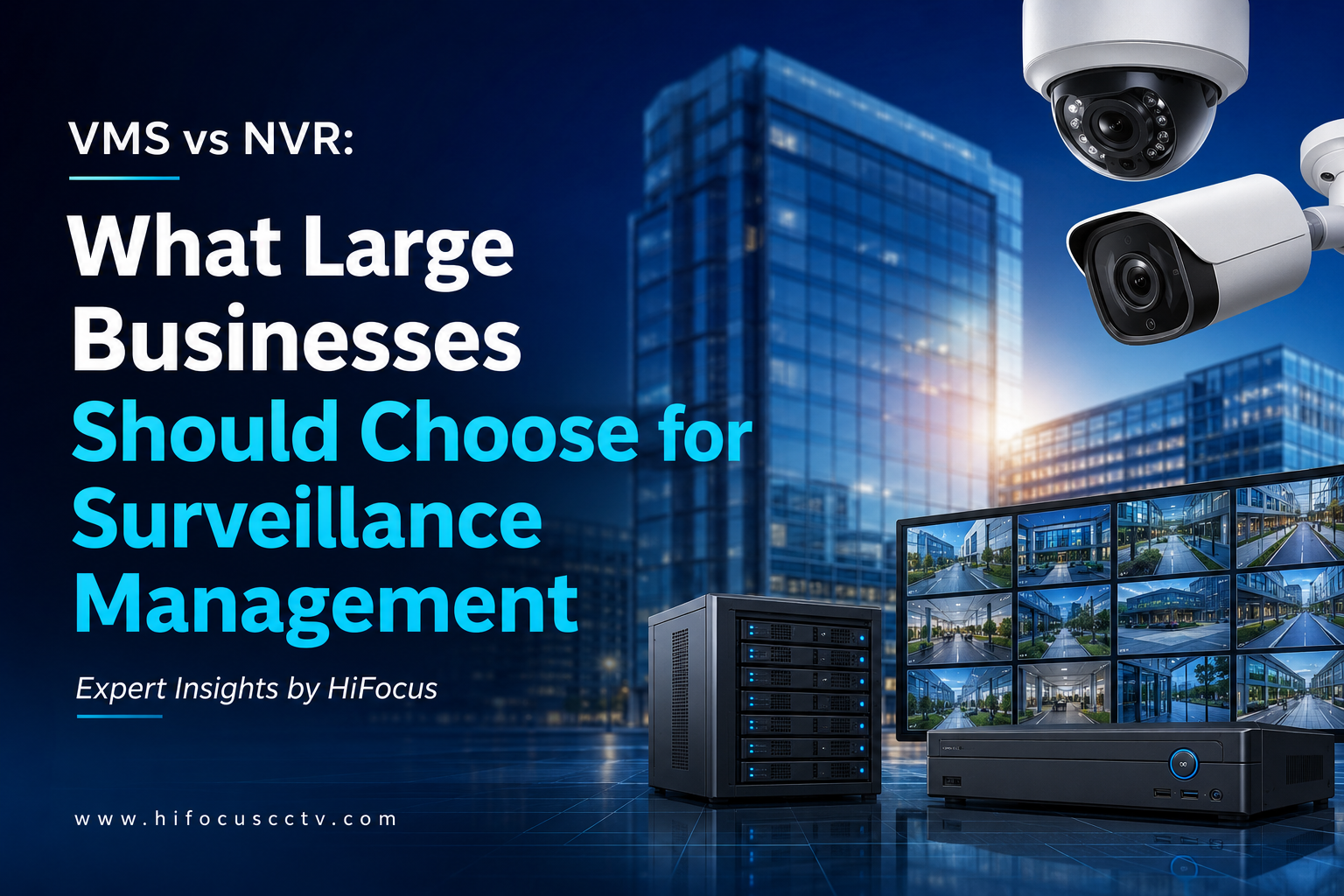
An NVR (Network Video Recorder) is a dedicated hardware appliance that records video from IP cameras over a network. Think of it as a purpose-built machine with embedded software that handles recording, storage, playback, and, in modern AI NVR models, basic video analytics right out of the box.
A typical NVR comes with a fixed number of channels (8, 16, 32, 64, up to 160), a set number of hard drive bays (1 to 16 SATA), pre-installed recording software, and a web or client interface for live viewing.
Where NVRs Make Sense
NVRs are the default choice for small to mid-sized deployments. They are:
Plug-and-play: Add cameras, assign IPs, and start recording within hours
Self-contained: No separate server, no Windows licensing, no IT admin required
Cost-effective at a small scale, a 16-channel NVR with 2 SATA bays costs a fraction of a VMS server
Reliable Purpose-built hardware, less prone to configuration drift
What Is a VMS? Understanding Video Management Software
A VMS (Video Management Software or Video Management System) is a software platform typically installed on a standard server or workstation that manages, records, and analyzes video from IP cameras across an entire network. Unlike an NVR, the VMS is not tied to a specific hardware appliance. You choose the server hardware, the storage array, and the software license independently.
What a VMS Gives You That an NVR Cannot
Single-pane-of-glass management: Every camera, every recorder, every site on one screen, regardless of where the video is stored.
Unlimited camera licensing potential. Software-based licensing means you pay per camera, not per hardware channel. Adding cameras does not require a new appliance.
Centralized or distributed recording: Record on the server, on edge devices, or both. Storage can be pooled across NAS or SAN arrays.
Enterprise-grade user management, role-based access, audit trails, and multi-tenant support for security operations centers (SOCs).
Advanced analytics and AI integration VMS platforms can ingest metadata from multiple analytics engines, run third-party AI models, and correlate events across cameras that are physically on different recorders.
Integration with third-party systems, access control, fire alarms, PSIM, and building management VMS is the integration layer. NVRs are typically closed or limited in API access.
VMS vs NVR: Side-by-Side Comparison
Parameter | NVR (Network Video Recorder) | VMS (Video Management System) |
Primary function | Recording + basic management | Enterprise video management + recording + analytics + integration |
Hardware | Purpose-built appliance | Standard server (or server + storage array) |
Scalability | Box-by-box (buy a new NVR to grow) | License-based (add cameras to the same server up to its capacity) |
Multi-site management | Limited (multiple logins) | Centralized (one dashboard across sites) |
Storage | Fixed per appliance (1–16 SATA bays) | Flexible (DAS, NAS, SAN, cloud tiers) |
Analytics | Onboard per-channel (model dependent) | Server-grade AI, multi-engine, cross-camera correlation |
User management | Basic (admin/user) | Role-based, multi-tenant, Active Directory integration |
Third-party integration | Minimal (limited API/ONVIF) | Extensive (API, SDK, access control, PSIM) |
IT dependency | Low | Moderate to high |
Ideal camera count | Up to ~160 per appliance | 50 to 10,000+ |
Typical deployment | Single building or small campus | Multi-building, multi-site, enterprise, city surveillance |
Starting cost (India) | ₹8,000–₹2,50,000 per unit | ₹1,00,000+ (server + software license) |
When to Choose NVR (Even for Large Businesses)
Despite the scalability advantage of VMS, there are scenarios where NVR is the smarter choice even for large organizations.
1. You Have Discrete, Self-Contained Sites
If your business has 10 standalone retail stores, each with 8–16 cameras, and each store operates independently, one NVR per store is simple, cost-effective, and trouble-free. There is no need for a central VMS server unless you want cross-location search or remote guard tours.
2. IT Infrastructure Is Limited
Many Indian facilities, factories, remote warehouses, and government extensions do not have the server room environment, UPS capacity, or IT staff to manage a VMS server. An NVR can live in a network closet and needs almost no maintenance beyond drive swaps.
3. You Want Per-Site Recording Autonomy
If each site needs to record independently, even if the network goes down, placing an NVR at each site is the standard approach. VMS can also support edge recording, but the architecture is more complex.
4. Budget Is Tight at the Start
For a 64-camera deployment, a single 64-channel NVR with 4–8 SATA bays is significantly cheaper than a VMS server + software license + potential SAN storage. If the budget does not justify VMS today, start with NVRs and plan a VMS migration later. HiFocus NVRs support ONVIF compliance, which makes future integration easier.
When to Choose VMS (Non-Negotiable Scenarios)
1. You Need a Central Security Operations Center (SOC)
If you are building a command center where operators monitor 200+ cameras from multiple sites on video walls, a VMS is not optional it is the foundation. Trying to stitch together multiple NVR GUIs on a video wall is a poor user experience and a security risk during incidents.
2. You Manage 200+ Cameras Across Multiple Buildings
Once you cross 200 cameras, the operational overhead of managing multiple NVRs (firmware updates, storage monitoring, user access, incident search) exceeds the cost of a VMS. A VMS reduces that overhead dramatically.
3. You Require Advanced AI or LPR at Scale
Running license plate recognition (LPR), face recognition, or people counting across 50+ entrances simultaneously requires processing power that most embedded NVRs cannot deliver. A VMS on a GPU-enabled server can handle this centrally.
4. You Need Tight Integration with Access Control or BMS
If your surveillance system needs to respond to access control events (e.g., door forced open triggers specific camera recording at a higher frame rate), or integrate with building management systems, you need a VMS with an open API. NVRs rarely offer this level of programmability.
5. You Are a System Integrator Managing Multiple Client Sites
A VMS with multi-tenant architecture lets you manage all client sites from one console without visiting each site. This is a game-changer for security service providers and system integrators in India.
Can You Use VMS and NVR Together?
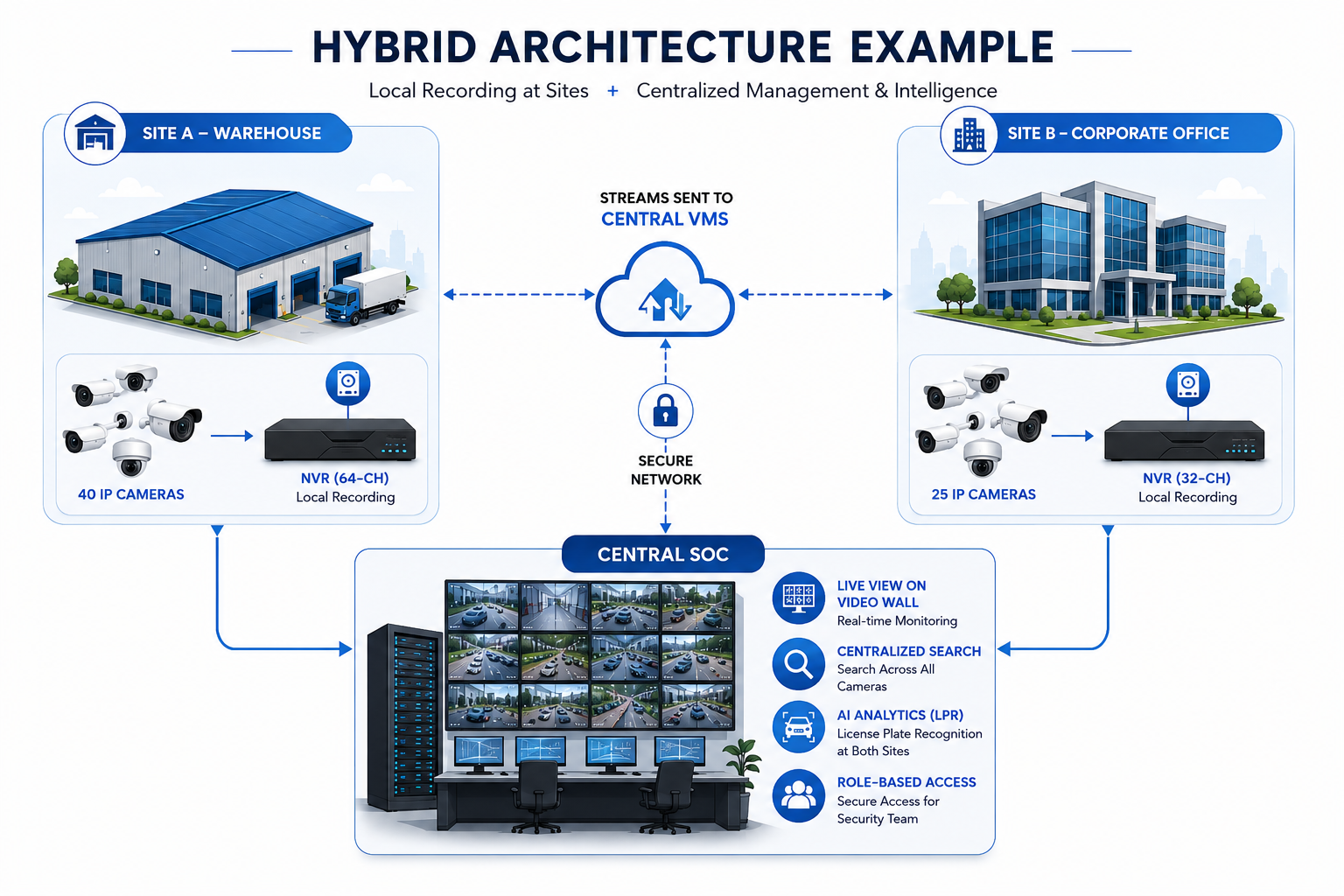
Yes, and in large Indian enterprises, this is actually the most common architecture.
Many organizations deploy NVRs at the edge (per building or per floor) for local recording and bandwidth efficiency, then aggregate those NVRs under a central VMS for unified monitoring and search.
In this setup, you get the reliability of local recording (even if the WAN goes down, Site A keeps recording on its NVR) plus the centralized management of VMS. This is the architecture we have deployed for clients like JIPMER (800+ cameras) and Gujarat Court projects.
Total Cost of Ownership: NVR vs VMS
Cost Component | NVR-Based (64 cameras) | VMS-Based (64 cameras) | NVR+VMS Hybrid (64 cameras) |
Recording hardware | 1× 64-ch NVR (~₹80,000–₹1,50,000) | 1× VMS Server (~₹2,00,000–₹5,00,000) | 1× 64-ch NVR + VMS license |
Software license | Included with NVR | ₹500–₹2,000/camera/year typical | NVR included + VMS license |
Storage (30 days, 4MP) | 4 × 4TB HDD (~₹40,000) | NAS/SAN + 4× 4TB (~₹60,000–₹1,00,000) | 4 × 4TB HDD in NVR (~₹40,000) |
Installation & setup | ₹15,000–₹25,000 | ₹30,000–₹50,000 (server config + networking) | ₹25,000–₹40,000 |
Annual maintenance | Low (drive replacement) | Moderate (OS patches, DB maintenance, server HW) | Low–Moderate |
3-year TCO (approx.) | ₹1,50,000–₹2,50,000 | ₹3,50,000–₹6,00,000+ | ₹2,20,000–₹3,50,000 |
What Matters for Large Indian Businesses Right Now
Three trends are shaping surveillance purchasing decisions in India today:
1. STQC Compliance for Government and PSU Projects
The government increasingly mandates STQC certification for surveillance equipment procured by central and state agencies. HiFocus is one of the few Indian manufacturers with STQC-certified products, covering both NVRs and IP cameras, making them a compliant choice for tenders.
2. Make in India and Data Localization
With data localization policies tightening and a push for indigenous manufacturing, Indian enterprises prefer domestically manufactured hardware. HiFocus manufactures its NVRs and servers in Chennai, which simplifies procurement compliance for government and institutional buyers.
3. AI at the Edge vs. AI at the Server
The market now offers AI processing at both levels. AI NVRs handle basic detection (person, vehicle, face) without a server. But for advanced use cases, ANPR across 20 lanes, crowd density analytics, behavior analysis, server-based VMS with GPU acceleration is necessary. HiFocus offers both options, including dedicated ANPR network cameras for number plate recognition
Still unsure? A free consultation with the HiFocus team can help map your requirements to the right architecture. Contact us for a no-obligation discussion.
Final Thoughts
The VMS vs NVR decision is not about which is "better." It is about what fits your operational reality.
For a single-site business with fewer than 100 cameras, an NVR is often the most practical and cost-effective choice. For a multi-site enterprise, a government campus, or a facility with complex integration needs, a VMS becomes essential. And for most large Indian businesses, a hybrid NVR+VMS architecture delivers the best of both worlds.
What matters more than the choice itself is working with a manufacturer who offers both options honestly without pushing you toward an overpriced solution or an underscaled one.
HiFocus is one of the few CCTV brands in India that manufactures NVRs, VMS servers, IP cameras, PTZs, and network switches under one roof, with STQC certification and a pan-India support network. Whether you need a single 8-channel NVR or a 1,000-camera VMS deployment, the product range and engineering depth exist to support it.
Explore NVR solutions · Explore VMS Server solutions · Book a consultation
Frequently Asked Questions
What is the main difference between VMS and NVR?
An NVR is a dedicated hardware appliance that records video from IP cameras and includes built-in management software. A VMS is a software platform (usually running on a standard server) that manages, records, and analyzes video across an entire organization, often aggregating feeds from multiple NVRs or directly from cameras.
Can VMS and NVR work together?
Yes. In fact, this is the most common architecture for large Indian enterprises. NVRs handle local recording at each site or building, and a central VMS aggregates all feeds for unified monitoring, search, and analytics.
Which is better for a business with 100 cameras, VMS or NVR?
For 100 cameras at a single site, a high-channel NVR (e.g., a 128 or 160-channel model) is usually more cost-effective. For 100 cameras across multiple sites, a VMS or hybrid approach is recommended for centralized management.
Do I need a VMS if I have multiple NVRs?
If you have 3 or more NVRs and your security team needs to view all cameras from one screen, search across all recorded footage without switching logins, or run centralized analytics, then yes a VMS is highly recommended.
What is the cost difference between VMS and NVR in India?
For a 64-camera deployment, an NVR-based setup costs approximately ₹1,50,000–₹2,50,000 over 3 years, while a VMS setup costs ₹3,50,000–₹6,00,000+. A hybrid approach falls in between.
Is VMS only for large enterprises?
Primarily, yes. VMS is designed for organizations with 100+ cameras, multiple sites, or complex integration needs. Smaller deployments (under 50 cameras at a single site) are typically better served by an NVR.
Can HiFocus NVRs integrate with third-party VMS platforms?
Yes. HiFocus NVRs support ONVIF Profile S/G/T and RTSP streaming, which makes them compatible with most major VMS platforms. For best results, the HiFocus VMS ecosystem is fully optimized with HiFocus hardware.
Does HiFocus offer both NVR and VMS solutions?
Yes. HiFocus manufactures a full range of Network Video Recorders (8 to 160 channels) and VMS Servers, including the HF Media Client and HF-VMS-AIS series, with pan-India support and STQC certification.
This guide was written by the HiFocus technical content team, drawing on real-world deployments across Indian enterprises, government institutions, and system integrator networks. For project-specific advice, reach out to our solutions team at HiFocus Contact.